Good Corporate Governance at the Heart of Business
TISCO prioritizes offering customers innovative, creative, and appropriate financial services to meet the needs of customers while adhering to the highest ethical and corporate governance standards. TISCO also recognizes that businesses must operate in conjunction with being a good citizen of society and taking care of all stakeholders.
Strength and Sustainability over 5 decades
Corporate Governance is the force that drives TISCO in financial and investment business. The Company’s commitment to the highest ethical standards and good corporate governance is the result of its belief that a truly successful business is one that conducts itself as a good corporate citizen of the society in which it operates. This can only be achieved by ensuring that the rights and interests of all stakeholders: shareholders, customers, employees, business partners, competitors, society and the environment, are fully protected.
Good Corporate Governance at the Heart of Business
Corporate Governance Code of Conduct is set up to provide guiding principles of good corporate governance in order to ensure that the company complies with all relevant laws and regulations and carries out duties with maximum accountability, transparency, and equitable treatment to all stakeholders.
TISCO established the Corporate Governance Policy based on the principles of good corporate governance for listed companies in 2006, as provided by the Stock Exchange of Thailand. This policy covers the governance structure, corporate governance practices, operating structure, duties of regulatory agencies, and centralized operating policies to ensure that the Company and its subsidiaries strictly comply with the Corporate Governance Policy.
Banking Industry Code of Conduct
TISCO operates our financial and investment businesses in an ethical manner based on the Banking Industry Code of Conduct. Our employees are encouraged to adhere to the highest standard of ethics.
The Board of Directors and Management have adopted the new Banking Industry Code of Conduct, revised in 2016, to govern our business practices in alignment with good corporate governance principles.
The Code encourages TISCO and its employees to conduct business with integrity, sustain the balance between turnover and the impact on shareholders and customers, and adhere to sustainable business practices by taking social and environmental consequences into account.
Director Nomination Policy
Policy on Assessing the Independence of Directors
The Board of Directors has adopted the Policy on Assessing the Independence of Directors with recognition on the importance of transparency in its determination of a Director’s independence. The independence criteria, with international standard in consideration, are determined annually and are according to the Corporate Governance Code for Listed Company 2017. This is to ensure that the directors are able to make independent analysis with transparency, prior to the benefits of shareholders and stakeholders.
Succession Planning
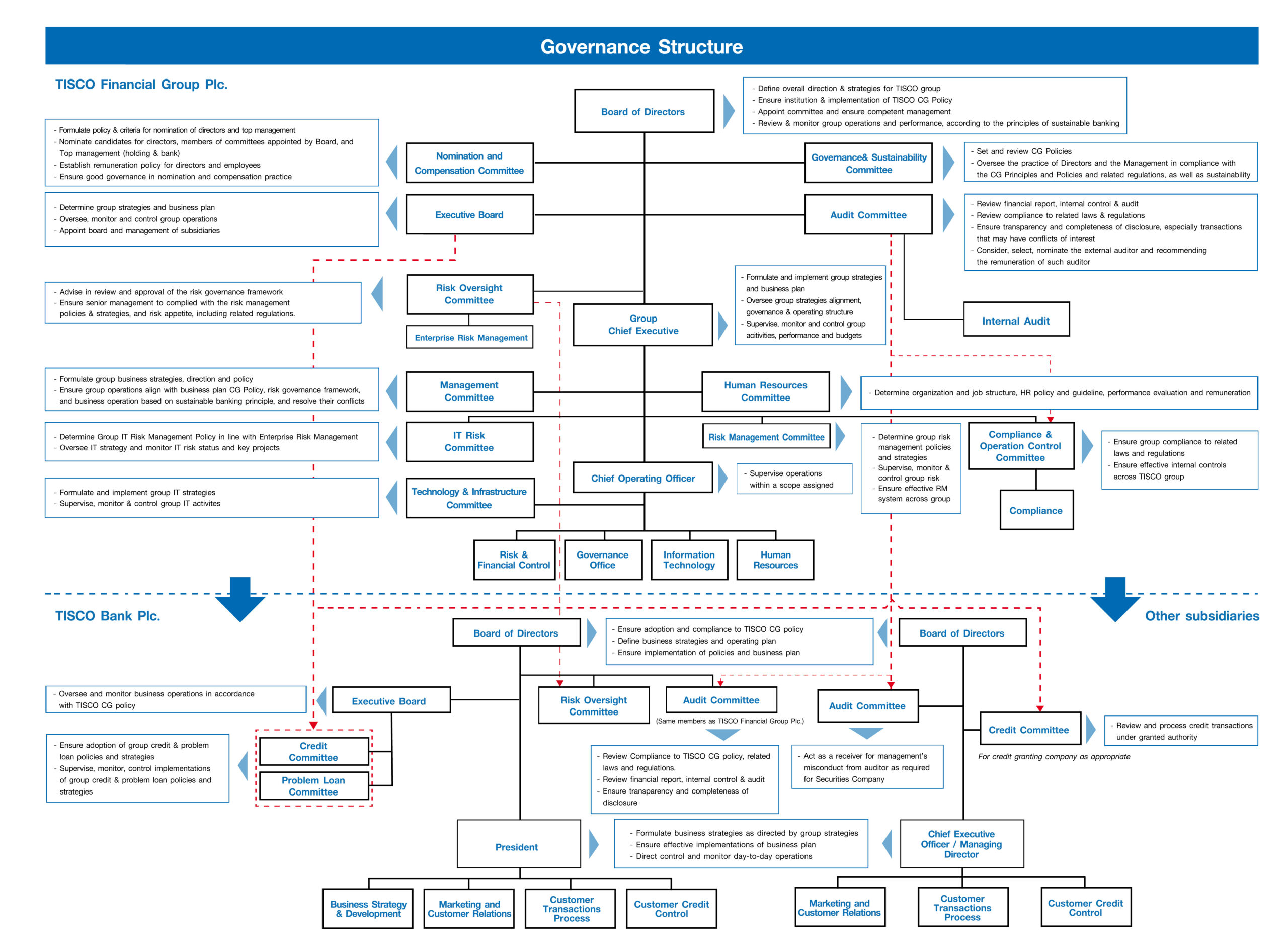
TISCO Group is aware of personnel readiness and prepared succession plan for all key positions to ensure stability and continuity of business operations. The Board of Directors assigns the Nomination and Compensation Committee to oversee the preparation and periodic review of Top Management’s succession plan, starting from determination of selection policy, criteria, format and process considering factors such as qualification, education, knowledge, proficiencies, skill, and experience related to the businesses of TISCO Group, as well as the evaluation of qualified successor for key job position in TISCO Group
Director and Executives Remuneration Policy
The remuneration of Directors, as proposed by the Nomination and Compensation Committee, shall be approved by the Annual General Meeting of Shareholders.
The scale and components of remuneration for Directors and Executives are determined based on the principle that remuneration should be sufficient to attract and retain qualified individuals, while avoiding excessive compensation. Directors’ remuneration is benchmarked against prevailing industry practices, taking into account experience, skills, knowledge, dedication, and the value each Director contributes to the Company. Comparisons are also made with listed companies of similar size and within comparable industries. Directors who are assigned additional duties, such as serving as members of Board Committees, are entitled to appropriate additional remuneration. Such remuneration is considered and approved by the Board of Directors.
The remuneration of the Group Chief Executive Officer, Senior Executives, Executive Vice Presidents, and Function Heads (collectively referred to as “Executives”) is aligned with individual performance and linked to the Company’s short‑term and long‑term operating results. Performance is assessed through a comprehensive set of Key Performance Indicators (KPIs) that reflect the Company’s commitment to being a responsible financial institution and are driven by its long‑term vision, mission, and strategic sustainability objectives. The KPIs comprise both financial and non‑financial indicators. Financial indicators cover key business performance metrics, while non‑financial indicators include customer performance and satisfaction, process improvement, risk management, regulatory compliance, internal control, and human capital development. The KPIs also incorporate indicators relating to responsible banking practices across economic, social, and environmental dimensions,
such as net profit to total assets, net profit to equity, return on assets (ROA), return on equity (ROE), customer satisfaction, and employee engagement survey results. These indicators are determined under transparent criteria, aligned with the responsibilities of each role, and reflect the Executives’ ability to drive TISCO Group’s Environmental, Social, and Governance (ESG) objectives. KPIs are tailored to the nature and strategic impact of each position.
To ensure that the remuneration structure aligns with good corporate governance principles, promotes executive accountability, and supports the creation of sustainable long‑term value for stakeholders, the Nomination and Compensation Committee considers and determines the remuneration framework, and proposes it to the Board of Directors for approval. The remuneration reflects performance outcomes based on both financial and non-financial indicators, consistent with the Company’s vision, mission, short‑term and long-term objectives, and its competitiveness relative to leading companies in Thailand.
In addition to financial KPIs, the compensation for executives is also linked to sustainability-related KPIs, which cover stakeholder engagement and satisfaction, the achievement of sustainability targets and initiatives, the maintenance and enhancement of sustainability and corporate governance standards, as well as progress in climate-related management and disclosure in accordance with relevant standards. Performance against these indicators during the preceding year is incorporated into the executive performance evaluation process and considered in determining executive compensation. This approach is intended to ensure that the compensation structure promotes sustainable value creation, prudent risk management, and the long-term interests of shareholders and all stakeholders. The Directors’ and Executives’ Remuneration Policy, as proposed by the Nomination and Compensation Committee, has been regularly reviewed and approved by the Board of Directors.
The executive remuneration structure comprises a monthly salary, other income such as a position allowance, a cost-of-living allowance, and welfare benefits, together with an annual cash bonus linked to TISCO Group’s performance. Executives may also be eligible to receive long‑term incentives, which are payable after a five-year period and are determined based on the average share price over the relevant period from the year of grant to the vesting date. Eligibility for such incentives is contingent upon continued employment with TISCO Group as of the vesting date. The Company reserves the right to suspend, reduce, or forfeit any unpaid long-term incentives in cases of serious disciplinary misconduct or actions causing material damage to the Group.
Remuneration is determined in accordance with the Director and Executives Remuneration Policy, as endorsed by the Nomination and Compensation Committee and approved by the Board of Directors. All remuneration approvals are subject to appropriate levels of approval to avoid conflicts of interest and ensure transparency.
In addition to remuneration payable to Directors of TISCO Financial Group Public Company Limited, the parent company, in 2025 the Group also paid remuneration to Directors who do not hold directorships in TISCO Financial Group Public Company Limited and/or do not hold full‑time management positions in TISCO Group subsidiaries, at the same structure and rate as applicable to Directors of TISCO Financial Group Public Company Limited, until otherwise amended. The Board of Directors of each subsidiary company, under authority delegated by its shareholders, determines the specific amount payable on each occasion. This does not preclude Directors from receiving additional remuneration or benefits for special assignments as approved by the Board of Directors.
Roles and Duties of the Corporate Secretary
The Board of Directors resolved to appoint Mr. Nipon Wongchotiwat, Head of Enterprise Risk and Credit Control, as Corporate Secretary, effective from January 1, 2026, to be responsible for preparing and maintaining director profile, notice and minutes of the board meeting, annual report, notice and minutes of shareholders meeting, maintaining directors and management’s report on conflict of interest, and performing other duties as required by the Capital Market Supervisory Board.